Wednesday, 4 April 2012
Julie & Julia Magazine Film Review Analysis
Genre Conventions Research: Julie and Julia Review
Image:
The review of the film Julie & Julia is dominated by a single main image of what looks to be the protagonist in a kitchen setting making food. The image connotes that the film may address the themes of family, cooking, friendship and the roles of mothers. The scenery consists of her wearing an apron cloth, in addition to having cooking apparatus such as plates and bowls again suggesting that the film may be largely based around the home or kitchen while also creating a very realistic situation that an audience can relate with. Again in terms of the image, we see a cheerful and happy smile on the centrally positioned character, suggesting a bit about her personality being warming, lighthearted with nothing to hide. This is also suggestive of the tone of the film being humorous and witty, as well as effectively easing the viewer in.
Language:
The tone of much of the review is quite humorous befitting the film's storyline and star actors; however it still contains elements of seriousness. Humour is self- evident in the use of such words like 'teeny kitchen' making the review very lighthearted. As a form of appeal to its audience, the reviewer uses terms such as 'us' involving the reader and making them more inclined to view the film. In addition to praising the credentials of the actors involved in the film like Meryl Streep, boasting 'Streep is to die for, so funny, touching so brilliant' which is effective because its engages the audience, which also makes them more inclined to watch the film. The review uses persuasive techniques in that they analysis the historical background and its relation to the film, for example, 'around the same time Kennedy brought culture and couture to the White House' which places the reviewer on a higher intellectual level and thereby making the reader more inclined to believe and trust them due to that fact that the reader themselves may not know about the historical background.
Layout:
In terms of the layout, the title is presented through the use of bold and black font immediately attracting the reader to the name of the film. The use of black and bold font is commonly used by Empire magazine as its acts as a motif for the whole magazine, this again makes them more recognisable to the reader as Empire are associating themselves with this colour and font.
The caption 'The cook, the wife, the star and her blogger' is used as a indication into the themes of the film, the use of such short words makes the reader want to view the film to find out the meaning of the collocation of these words, which is again effective in making them more inclined to view the film.
Tuesday, 3 April 2012
Initial/possible idea for short film (#1)
Planning - First Thoughts:
Our concept for our film is, in essence, a five minute walk, from one friend’s house to another’s, seen in real time. The idea here is to give the film a sense of randomness, realism and spontaneity. The idea is also about trying to mix reality with the weird/bizarre, and the mundane with the extraordinary. Some things just happen – they cannot be explained or justified, they simply are.
The film begins with an arresting and intriguing extreme close up of a pair of hands, which are both dripping with blood. This immediately catches the viewer’s attention, and makes them want to continue to watch the film, possibly confusing them and alarming them, but nonetheless, grabbing their attention almost immediately.
There is then a shot of a person, presumably the very same person whose hands we have just seen, walking away, into the distance. The camera than pans back to reveal a pair of legs, presumably a person’s body, lying dead on the floor. In mid pan, we cut to the title card of the film.
We are then introduced to a young man who is seen talking to his friend on the phone. His friend has asked him to come over to his house and he has accepted. We are then given brief flashes of the young man getting dressed and ready to go. His getting ready is shown in a sort of music video type fashion, possibly to highlight the fashions and styles of today’s youth, and to create a sense of verisimilitude.
The young man is then shown leaving his flat and beginning his walk. As he does, his interior monologue begins. The idea here is to create a very internalised film, almost a “documentary of the mind,” in that we follow the character, gaining an insight into their way of thinking, and learning a thing or two about them throughout the course of the film.
The young man than passes another young man, dressed in a long black coat, who is walking very rapidly, almost in a sacred, frenzied, paranoid panic. The two young men bump into each other, and the young man in the coat drops his wallet, but continues to walk. The young man bends down to pick it up and, as he does, it flips open and he sees that the inside of the wallet is stained with bloody finger prints. The other young man suddenly returns, snatching the wallet out of his hands, and thanking him very much for picking it up. He then walks away.
The young man continues his walk to his friend’s house. As he does, he begins to question whether the young man he just bumped into had done something wrong/committed a murder. He then brushes this off, thinking of his idea as stupid and nonsensical and not possible.
The young man than spots, from across the road, a couple having a very loud argument in the middle of the street, with the young woman’s dialogue along the lines of “I can’t believe you did that! How could you be so stupid? Do you know how much money I’ve saved up for that thing? Urgh, I hate you!”
The young man, unable to stop himself, yells “A bit of a strange place to have a domestic, don’t you think, mate?” The boyfriend from across the street yells an obscenity at him but he just laughs it off and continues walking.
The boyfriend from across the street is then seen crossing to the other side of the street, seemingly in an enraged rush. The young man then becomes more and more unnerved and fearful, possibly thinking that this boyfriend is going to hurt him for what he said, or there is going to be a confrontation of some sort. This is told through continuous close-ups and quick cuts back and forth between the two men.
The boyfriend is then seen striding past him, and off into the distance, as the young man is seen turning a corner, into a secluded road, which presumably is where his friend’s house is.
We are then shown the exterior of a jeweller’s. This shot confuses us, as we do not know why we are seeing this and have no idea what use this is to the plot. We then see a static long shot of pedestrians walking outside the area of the shop. We then see a very familiar figure appearing in the distance, but we have no idea who it is exactly.
We then cut to the secluded road, where the young man is seen walking towards his friends house. Everything is very quiet, and the tension here is extreme. Out of nowhere, the young man’s phone rings. He picks it up, and has a very quick conversation with his friend, telling him that he is almost there. He then hangs up. When he does, he sees a figure, walking towards him in the distance.
FROM THIS POINT ON, WE CUT BACK AND FORTH BETWEEN THE STATIC SHOT OF OUTSIDE THE JEWELLER’S AND A P.O.V. SHOT OF THE YOUNG MAN, WALKING CLOSER AND CLOSER TOWARDS THE FIGURE IN THE DISTANCE, UNTIL BOTH FIGURES MERGE INTO ONE, ALMOST.
The figure that is walking towards the young man is the other young man with the bloody wallet. He is seen holding something in his hands. We cannot tell what it is at first, but it is then revealed to be a knife.
The other young man, in a frenzy, lunges for the young man, and strikes him in the stomach. A close up of the young man’s face reveals his shock and pain. His hands suddenly grip for his stomach and we see that his hands are covered in blood. These are the same hands we saw at the start of the film.
There is then a brief exchange of dialogue between both young men: “Why?” “I’m so sorry.” The young man than falls, presumably to his death. This is interrupted by a shot of the boyfriend walking into the jeweller’s shop and choosing a ring almost at random from behind the counter.
We are then presented with the same shot of the killer walking into the distance, and the pan towards the young man, lying dead in the street. The image of the blood and the shot of the figure walking away from the body implies that the shot of the victim falling and dying has been deliberately cut out in order to confuse and shock the audience, and to manipulate them into thinking one thing when something completely different has taken place.
The boyfriend who was just in the jeweller’s returns to his girlfriend and, slapping the ring in her hand, shouts “There’s your bloody ring!” and walks off into the distance.
The film ends with a close up of the young man’s dead, serene face, before a white-out and credits.
Monday, 2 April 2012
'Hell Is Around the Corner,' - Final draft script
FADE IN ON
EXTREME CLOSE UP of a pair of BLOODY BLACK HANDS.
(NOTE: The atmosphere here should most likely be surreal and dreamlike).
CUT TO
A PAIR OF FEET IN SHINING BLACK LEATHER BOOTS walks away and OUT of FRAME.
HOLD on vacant shot of STREET for a moment or two, then SLOWLY PAN to the RIGHT to reveal a pair of LIMP LEGS (more than likely a person's body) lying on the ground.
In MID PAN we CUT TO the film's TITLE CARD.
A FLASH OF WHITE LIGHT brings us to
THE INTERIOR OF A YOUNG BOY'S (DAMMY'S) BEDROOM.
He is in bed, on the phone, with his friend, who is not heard.
(NOTE: During his conversation of his friend, we get brief shots of items around his rooms to connote a sense of naivety and youthfulness, such as a Willy Wonka DVD, a stack of comic books, and a tall pile of school books).
DAMMY
(into phone)
Yo, man, what's up, you alright? What's the plan for today?
(beat)
I don't even know, man.
(beat)
We could hit up Westfields if you like. I think they've got sales on?
(beat)
Yeah, alright, then. I'll see you in a bit.
(into phone)
Yo, man, what's up, you alright? What's the plan for today?
(beat)
I don't even know, man.
(beat)
We could hit up Westfields if you like. I think they've got sales on?
(beat)
Yeah, alright, then. I'll see you in a bit.
We are then presented with BRIEF SHOTS of Dammy getting ready and putting on ARTICLES OF CLOTHING (i.e., baseball cap, coat, shoes, etc).
CUT TO
ESTABLISHING SHOT of Dammy's HOUSE.
Dammy is seen exiting his house and beginning his walk.
CUT TO
ESTABLISHING SHOT of Dammy's HOUSE.
Dammy is seen exiting his house and beginning his walk.
CUT TO
A TRACKING CLOSE UP shot of Dammy's face as we hear his INTERIOR MONOLOGUE:
DAMMY
(voice-over)
Bloody hell, what a great day! Gonna get my Vans...oh yeah! Saw a top in H&M, need to get that, too. Only £25 pounds, I think. Absolute bargain!
(beat)
Bit grey, this weather, isn't it? I hope it doesn't rain. Days like these really bring out the worst in people.
(voice-over)
Bloody hell, what a great day! Gonna get my Vans...oh yeah! Saw a top in H&M, need to get that, too. Only £25 pounds, I think. Absolute bargain!
(beat)
Bit grey, this weather, isn't it? I hope it doesn't rain. Days like these really bring out the worst in people.
CUT TO
OVER THE SHOULDER SHOT of Dammy.
In the distance, we see another young man (Steven), a man who is taller and a bit more stocky, wearing a long black jakcet and a pair of leather gloves. He is walking in a paranoid, frenzied shuffle.
CUT TO
TWO SHOT of both Dammy and Steven BUMPING in to one another.
(NOTE: This shot is presented to us in slow motion to add emphasis to the action).
CUT TO
EXTREME CLOSE UP of Steven's WALLET dropping out of his pocket. It FLIPS OPEN and we are given a brief, teasing look into the inside of it. We see what appears to be bloody fingerprints all over the cards and the inside leather money slip.
(NOTE: THE FOLLOWING IS TO BE SHOT AS WRITTEN - Dammy is positioned to the LEFT of FRAME. He is shown PICKING UP the wallet. On the RIGHT of Dammy, in the background, is Steven, watching him looking at the wallet.
CUT TO
CLOSE UP of a Dammy's face as he sees, in horror and confusion, the bloody sight.
DAMMY
(interior monologue)
What is this? Blood? Is this blood?
Steven slowly approaches Dammy, appearing more and more in focus.
Steven extends his hand and SLAMS it down on Dammy's shoulder.
Dammy suddenly jerks around in FEAR AND PANIC:
Steven extends his hand and SLAMS it down on Dammy's shoulder.
Dammy suddenly jerks around in FEAR AND PANIC:
STEVEN
(coldly)
That's my wallet you've got there.
(coldly)
That's my wallet you've got there.
CUT TO
TIGHT TWO SHOT as
Both look down at the wallet, then stare up at each other. Dammy looks at Steven for a moment.
CUT TO
DAMMY'S POINT OF VIEW
He sees a dab of red blood in amongst the vast sea of black leather.
Dammy and Steven stare up at each other, Dammy fearfully. Steven looks at him seriously.
TIGHT TWO SHOT as
Both look down at the wallet, then stare up at each other. Dammy looks at Steven for a moment.
CUT TO
DAMMY'S POINT OF VIEW
He sees a dab of red blood in amongst the vast sea of black leather.
Dammy and Steven stare up at each other, Dammy fearfully. Steven looks at him seriously.
DAMMY
(unsure, trying to contain his panic)
Oh, sorry, sorry! Here!
(shoving the wallet into his hand)
Take it! It's yours! I found it on the floor!
(unsure, trying to contain his panic)
Oh, sorry, sorry! Here!
(shoving the wallet into his hand)
Take it! It's yours! I found it on the floor!
Once Dammy gives back the wallet, they trade ONE FINAL GLANCE, before Dammy turns and exits.
CAMERA STAYS POSITIONED BESIDE STEVEN. He watches Dammy walk away into the distance.
CUT TO
A CLOSE UP TRACKING SHOT of Dammy's face.
CAMERA STAYS POSITIONED BESIDE STEVEN. He watches Dammy walk away into the distance.
CUT TO
A CLOSE UP TRACKING SHOT of Dammy's face.
DAMMY
(interior monologue)
He was bloody strange! The way he looked at me, it was like he wanted to kill me! Argh, he gives me the creeps!
(beat)
...And that blood! That blood! What was with that blood?
(beat)
Nah, forget it. Out of sight, out of mind. Just put it out of mind.
(interior monologue)
He was bloody strange! The way he looked at me, it was like he wanted to kill me! Argh, he gives me the creeps!
(beat)
...And that blood! That blood! What was with that blood?
(beat)
Nah, forget it. Out of sight, out of mind. Just put it out of mind.
CUT TO
"THE TRAIL OF DEATH."
On the approach to his friend's house, Dammy notices the following:
A) A DEAD PLANT.
B) THE FRONT PAGE OF A NEWSPAPER DETAILING MANY DEATHS/A VERY FAMOUS HISTORICAL DEATH.
C) A DEAD ANIMAL.
These shots are complemented with CLOSE UPS of Dammy staring at them in bewilderment.
CUT TO
Dammy turns the corner and begins to walk down a long, secluded alleyway/side street. The atmosphere here is very dark and chilling. There is hardly a sound, except for Dammy’s worried breathing and the quiet hubbub from the main street.
DAMMY
(interior monologue)
Just a couple more minutes. You’ll be there in a couple of minutes. Just calm down.
(interior monologue)
Just a couple more minutes. You’ll be there in a couple of minutes. Just calm down.
As he walks down the alley, he sees, in the distance, a man, dressed in a black coat, walking at a slow, casual pace. As Dammy gets nearer and nearer, he/we begin to consider whether it is Steven, the man from the previous scene:
Dammy’s eyes light up with panic:
DAMMY
(interior monologue)
Is that him? Is that HIM?! Oh, my God!
(beat)
No no no no no it’s not possible it’s not possibly it’s not him!
(interior monologue)
Is that him? Is that HIM?! Oh, my God!
(beat)
No no no no no it’s not possible it’s not possibly it’s not him!
From Dammy’s P.O.V., we get closer and closer to the figure in the distance until there is absolutely no denying that it is him.
DAMMY
(interior monologue)
Oh my god oh my god what does he want what does he want???
(interior monologue)
Oh my god oh my god what does he want what does he want???
Dammy and Steven meet in the middle of the road. Dammy, scared out of his wits, says, stuttering:
DAMMY
La-listen, I-I, uh, I don’t want any...
Steven slow pulls something from out of his pocket – a pair of keys. He holds them forward, offering them to Dammy.
STEVEN
(in a slow, deliberate fashion)
You dropped your keys, mate.
(putting them in his hand)
There you go. Always believed in being the Good Samaritan, me.
(in a slow, deliberate fashion)
You dropped your keys, mate.
(putting them in his hand)
There you go. Always believed in being the Good Samaritan, me.
Dammy breathes an immense sigh of relief.
DAMMY
Phew! Thank God!
(beat, laughs)
You know, for a second there, you really frightened me...
Phew! Thank God!
(beat, laughs)
You know, for a second there, you really frightened me...
STEVEN
It’s alright, mate. No harm done.
They both look at each other.
It’s alright, mate. No harm done.
They both look at each other.
DAMMY
(putting his hand on his shoulder)
Thank you...!
(putting his hand on his shoulder)
Thank you...!
From Dammy’s P.O.V., we see Steven quickly glance at his hand on his shoulder, then slowly look up at him, squarely in the face.
He smiles, very faintly, before QUICKLY BRANDISHING A HAMMER AND SMASHING DAMMY OVER THE HEAD WITH IT!
CUT TO BLACK!
THE END
Sunday, 1 April 2012
Notes for script
Planning - Working Notes:
1) Ahmed could play the naive boy and Dammy could play the killer. Dammy is capable of pulling off being very intimidating and cold and detached, and Ahmed can pull off being naive and stupid and oblivious to what is going on.
2) If Ahmed were to play the boy, we would have to slightly tone down the opening dialogue and replace it with something a little less “street.”
3) When he sees the blood on the killer’s coat, there should be a ZOOM IN, so that it not only takes on a raw, bloody meaning but also almost engulfs the screen in red, almost as if it is a flashing light or an alarm bell of this boy’s guilt/crime.
4) When he hands back the wallet, there should be a shot of the hands, which connotes a passing away, and also that his life is now in the killer’s hands.
5) There are so many different ways in which we can show/signify the killer killing the boy. We do not see blood, but we see the actual hit, possibly from the young boy’s point of view, putting us right in his shoes. Also, both the slamming of the hand on the shoulder and the killing should both be presented with a similar sound, such as a crashing sound or a distorted scream; something violent sounding, basically.
6) There should also be a shot of the clouds up above when he says “I hope it doesn’t rain...” Grey clouds connote a sense of foreboding, and the feeling that there is not something quiet right going on here.
7) Places/things would could connote death include a bordered up pub (which is near my house, but I do not know if we need permission), a boarded up house, and lilies. The lilies could be one or a dozen, a wrecked bouquet that the boy sees on the ground with the petals blowing in the wind, for instance.
Friday, 30 March 2012
Film Influences
Planning - Filmic Influences:
The Seventh Seal:
There are several reasons as to why we have chosen Ingmar Bergman’s ‘The Seventh Seal,’ as one of our influences for our short film.
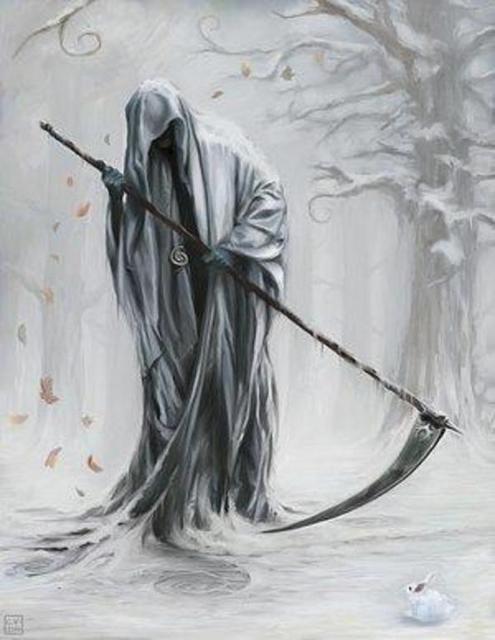
The first, and probably the most obvious and blatant, is that ‘The Seventh Seal’ features one of the most famous images in cinema history, that of Death, played by Benget Ekerot, appearing suddenly on a beach in the opening scene, armed with a scythe, ready to take Antonious Block, played by Max Von Sydow, away into death. Given the nature of our film (i.e., dealing wholly with the theme and nature of death, and using lots of death imagery), it felt appropriate to sit ‘The Seventh Seal,’ as an influence because A) it is, as we have said, one of the most famous examples/depictions of Death in film, and B) because there are themes within ‘The Seventh Seal,’ which are clearly echoed within our film (i.e., that of Death coming to take an person unexpectedly, etc, etc), and so it felt fitting to use this film as an influence.
The second is the heightened use of ambient and natural sounds. In our film, we are planning to present all aspects of the ‘world,’ within our film, in particular the sounds and scenery, in such a way that it proves to be very disarming and disorientating towards the viewer. We feel that ‘The Seventh Seal,’ is a perfect springboard in order to allow us an insight into how to do this effectively.
The third and final reason is the use of Gunner Fischer’s black and white cinematography. Since it is arguable that the use of black and white cinematography within ‘The Seventh Seal,’ was used by Bergman in order to act as a metaphor for death itself and the bleak situations the characters find themselves in, we feel that it would be a worthwhile consideration to shoot our film in black and white, as this would be, like ‘The Seventh Seal,’ the perfect way to get our point across.
The Godfather:
There are several reasons as to why we have chosen Francis Ford Coppola's 'The Godfather' as one of our influences for our short film.
The first is Coppola’s heightened use of sound. In the earlier part of the scene, before Don Corleone is shot, there is the very loud and distracting use of a trumpet. It may be implied that this trumpet sound, whilst maybe just being there in order to add an extra layer of “street realism,” to the piece, and to be very much in keeping with the time and place in which it was set (i.e., 1940s Italian America, etc), it may also have been used to add emphasis to or foreshadow a particular event (i.e., Don Corleone’s shooting).
The second is the way in which Don Corleone’s murder has been staged/framed. Coppola makes heavy use of medium close ups of both the Don and his assassins in order to possibly add emphasis, drama and tension to what is going to happen/is happening, and trying to draw the audience closer to the action. The use of the medium close up of the weapons may be to, again, emphasise danger, and that this man is going to be killed. Also, the guns possibly connote phallic imagery, which may add to the feeling that this killing is very much to do with honour and respect, themes which are stereotypically linked to the male psyche. Finally, the use of a single, unbroken take of the Don as he slips from the car in agony is not only effective in hammering home the point that this man is close to death, but is also (as was the case with ‘The Seventh Seal,’) one of the most famous and iconic moments in film history, and this again gives us a springboard for our own ideas and the desire to, with our film, create images which are just as visually powerful as the ones we have sited.
The third and final reason is Coppola’s use of costume. For instance, the Don is presented as wearing a long, brown coat and a pinched Fedora hat. This is effective as this is indicative of who this character is (i.e., that he is a smart, sophisticated man with a wonderful dress sense). Also, not only is this choice of dress indicative of the sort of character we are watching, but it is also indicative of the period in which the film is set (i.e., late ‘40s, etc). This helps to create a sense of realism and verisimilitude and has given us ideas in to how we can dress our characters in our film to create the same type of feeling.
American Psycho:
http://www.youtube.com/watch?v=IXlkq9vHuAE
NOTES: Bateman's interior monologue, the use of music, fitting with the motifs of the film and the character's construction.
Taxi Driver:
Again, the music is very brooding, the scene itself is very internalized, giving us the events going on in New York from his point of view. What he talks about fits in with what we see on screen. His interior monologue is very judgemental of the society which is being portrayed. We are using this because it is, again, a classic example of proper use of interior monologue which we wish to integrate into our film. There are constant use of extreme close ups in addition to slow motion shots, which helps to further internalize the events seen on screen, and to imply that we are seeing a biased, twisted view of society. Also wished to use slow motion in our film which again is seen in this extract.
Peep Show:
http://www.youtube.com/watch?v=NOe5n8M0ldw
NOTES: Very realistic, full of versimilitude. Also, comedic in style, which is expressed through in interior monologue. Also, again, what is heard in the monologue complements what is seen on screen.
The Texas Chain Saw Massacre:
We have also selected Tobe Hooper's 'The Texas Chainsaw Massacre,' as an influence in our film because of the way in which Hooper chose to introduce the killer, Leatherface, and the way in which he kills his victim, is almost identical to our film. To explain - we want our film to end very much with a "surprise," that the audience never sees coming (i.e., the young boy being killed by being hit with the hammer). Since a possible way of presenting this can be through a point of view shot, and since the way in which the shot in 'Texas Chainsaw' is presented is very similar to a p.o.v. shot, it felt appropriate to site this as an influence. Also, the overall atmosphere of the piece, and the way in way Hooper gauges tension (such as the animal noises, the constant cutting back and forth between Kirk and the empty, ominious doorway [which is, arguably, similar to our film, metaphorical of death and a transition into the unknown]) is undoubtly a major influence on us, and that is why we have selected 'Texas Chainsaw' as one of our influences for our film.
Wednesday, 28 March 2012
Music influences
Planning - Musical Influences:
Aftermath - Tricky:
This song helps to establish an uneasy atmosphere. It is ideal for the opening credit music of a film such as ours, in that it is very mysterious, intriguing and captivating. Also, considering that it is a hip-hop/r’n’b song, it helps to combine the eerie and the strange with the modern and the current, which are themes which flow through our film.
Blame It on the Boogie - The Jacksons:
Fix Up, Look Sharp - Dizzee Rascall:
These songs help to stay in keeping with a sense of naivety and innocence which is prevalent within the character. They could be played during the dressing up scene, serving to make meaning by setting a tone that helps establish the character. These songs are also in keeping with current trends of music that youths listen to today, therefore contributing to the realism.
Music for Strings, Percussion and Celestia - Bela Bartok:
This piece of music is a key influence on the music which we should use during the scene in which we are introduced to the killer. This music is very mysterious, strange and ominious. It is also revealing as it implies something extremely odd and bad about this character. It is almost as if we are being warned about this character by hearing this music. Also, as there are no lyrics, and this is a classical piece, it is fitting as the representation of silent killer is a classic of the thriller genre. The effect achieved is that this piece of music is his theme tune, connoting menace and evil.
Hell is Round the Corner - Tricky:
Teardrop - Massive Attack:
Teardrop - Newton Faulkner:
These two pieces of music are very downbeat, grungy and dirty, and are capable of evoking a strong response within our audience. The music ends the film on a bleak and pessimistic down note – there is no doubt that this boy is dead.
Ideas for Film
Planning Ideas:
Settings:
Costume:
Iconography:

Settings:
- Set on a cold, gloomy overcast day.
- Show how the natural elements of the scenery are decaying or dead, shown via the depiction of dead plants, dead leaves and maybe even dead animals.
- Consider possibly shoot in black and white to convey a bleak atmosphere, although this choice would not allow emphasis of the bright red of the blood.
Costume:
- The young boy should be dressed in a shirt, jeans and trainers, all of which are bright in colour. This adds a sense of naivety to him, in keeping with his age, inexperience and well-intentioned behaviour in the situation. Also, this creates a sense of versimilitude since it is not unlikely that a boy in this day and age would wear something like this.
- The killer should wear a long black coat, and possibly a pair of black leather gloves to add to his suspicious, menacing, evil persona, connotively linking him with the Grim Reaper type figure of superstitious folklore.
Visual motifs/aesthetics:
- The colours used should deep, bold and almost stingingly painful to the eyes of the audience, for example, the reds should be really, really red, and the blacks should be really, really black.
Iconography:
- Symbolically, the secluded road acts as a metaphor for a route towards death. This setting should be lit with bright white light, as this serves to symbolise the passing into death.

Poster:
- We are considering using a still image from our finished film, which we feel will perfectly encompass the tone of our film. This image consists of our protagonist and our antagonist caught together within the same frame. Our protagonist (a young, naive boy) is pictured picking up a bloody wallet in the foreground and staring at it in bewilderment. In the foreground is our antagonist, watching the young boy looking at the wallet with murderous intent clearly on his mind.
Subscribe to:
Posts (Atom)