Friday, 30 March 2012
Film Influences
Planning - Filmic Influences:
The Seventh Seal:
There are several reasons as to why we have chosen Ingmar Bergman’s ‘The Seventh Seal,’ as one of our influences for our short film.
The first, and probably the most obvious and blatant, is that ‘The Seventh Seal’ features one of the most famous images in cinema history, that of Death, played by Benget Ekerot, appearing suddenly on a beach in the opening scene, armed with a scythe, ready to take Antonious Block, played by Max Von Sydow, away into death. Given the nature of our film (i.e., dealing wholly with the theme and nature of death, and using lots of death imagery), it felt appropriate to sit ‘The Seventh Seal,’ as an influence because A) it is, as we have said, one of the most famous examples/depictions of Death in film, and B) because there are themes within ‘The Seventh Seal,’ which are clearly echoed within our film (i.e., that of Death coming to take an person unexpectedly, etc, etc), and so it felt fitting to use this film as an influence.
The second is the heightened use of ambient and natural sounds. In our film, we are planning to present all aspects of the ‘world,’ within our film, in particular the sounds and scenery, in such a way that it proves to be very disarming and disorientating towards the viewer. We feel that ‘The Seventh Seal,’ is a perfect springboard in order to allow us an insight into how to do this effectively.
The third and final reason is the use of Gunner Fischer’s black and white cinematography. Since it is arguable that the use of black and white cinematography within ‘The Seventh Seal,’ was used by Bergman in order to act as a metaphor for death itself and the bleak situations the characters find themselves in, we feel that it would be a worthwhile consideration to shoot our film in black and white, as this would be, like ‘The Seventh Seal,’ the perfect way to get our point across.
The Godfather:
There are several reasons as to why we have chosen Francis Ford Coppola's 'The Godfather' as one of our influences for our short film.
The first is Coppola’s heightened use of sound. In the earlier part of the scene, before Don Corleone is shot, there is the very loud and distracting use of a trumpet. It may be implied that this trumpet sound, whilst maybe just being there in order to add an extra layer of “street realism,” to the piece, and to be very much in keeping with the time and place in which it was set (i.e., 1940s Italian America, etc), it may also have been used to add emphasis to or foreshadow a particular event (i.e., Don Corleone’s shooting).
The second is the way in which Don Corleone’s murder has been staged/framed. Coppola makes heavy use of medium close ups of both the Don and his assassins in order to possibly add emphasis, drama and tension to what is going to happen/is happening, and trying to draw the audience closer to the action. The use of the medium close up of the weapons may be to, again, emphasise danger, and that this man is going to be killed. Also, the guns possibly connote phallic imagery, which may add to the feeling that this killing is very much to do with honour and respect, themes which are stereotypically linked to the male psyche. Finally, the use of a single, unbroken take of the Don as he slips from the car in agony is not only effective in hammering home the point that this man is close to death, but is also (as was the case with ‘The Seventh Seal,’) one of the most famous and iconic moments in film history, and this again gives us a springboard for our own ideas and the desire to, with our film, create images which are just as visually powerful as the ones we have sited.
The third and final reason is Coppola’s use of costume. For instance, the Don is presented as wearing a long, brown coat and a pinched Fedora hat. This is effective as this is indicative of who this character is (i.e., that he is a smart, sophisticated man with a wonderful dress sense). Also, not only is this choice of dress indicative of the sort of character we are watching, but it is also indicative of the period in which the film is set (i.e., late ‘40s, etc). This helps to create a sense of realism and verisimilitude and has given us ideas in to how we can dress our characters in our film to create the same type of feeling.
American Psycho:
http://www.youtube.com/watch?v=IXlkq9vHuAE
NOTES: Bateman's interior monologue, the use of music, fitting with the motifs of the film and the character's construction.
Taxi Driver:
Again, the music is very brooding, the scene itself is very internalized, giving us the events going on in New York from his point of view. What he talks about fits in with what we see on screen. His interior monologue is very judgemental of the society which is being portrayed. We are using this because it is, again, a classic example of proper use of interior monologue which we wish to integrate into our film. There are constant use of extreme close ups in addition to slow motion shots, which helps to further internalize the events seen on screen, and to imply that we are seeing a biased, twisted view of society. Also wished to use slow motion in our film which again is seen in this extract.
Peep Show:
http://www.youtube.com/watch?v=NOe5n8M0ldw
NOTES: Very realistic, full of versimilitude. Also, comedic in style, which is expressed through in interior monologue. Also, again, what is heard in the monologue complements what is seen on screen.
The Texas Chain Saw Massacre:
We have also selected Tobe Hooper's 'The Texas Chainsaw Massacre,' as an influence in our film because of the way in which Hooper chose to introduce the killer, Leatherface, and the way in which he kills his victim, is almost identical to our film. To explain - we want our film to end very much with a "surprise," that the audience never sees coming (i.e., the young boy being killed by being hit with the hammer). Since a possible way of presenting this can be through a point of view shot, and since the way in which the shot in 'Texas Chainsaw' is presented is very similar to a p.o.v. shot, it felt appropriate to site this as an influence. Also, the overall atmosphere of the piece, and the way in way Hooper gauges tension (such as the animal noises, the constant cutting back and forth between Kirk and the empty, ominious doorway [which is, arguably, similar to our film, metaphorical of death and a transition into the unknown]) is undoubtly a major influence on us, and that is why we have selected 'Texas Chainsaw' as one of our influences for our film.

Wednesday, 28 March 2012
Music influences
Planning - Musical Influences:
Aftermath - Tricky:
This song helps to establish an uneasy atmosphere. It is ideal for the opening credit music of a film such as ours, in that it is very mysterious, intriguing and captivating. Also, considering that it is a hip-hop/r’n’b song, it helps to combine the eerie and the strange with the modern and the current, which are themes which flow through our film.
Blame It on the Boogie - The Jacksons:
Fix Up, Look Sharp - Dizzee Rascall:
These songs help to stay in keeping with a sense of naivety and innocence which is prevalent within the character. They could be played during the dressing up scene, serving to make meaning by setting a tone that helps establish the character. These songs are also in keeping with current trends of music that youths listen to today, therefore contributing to the realism.
Music for Strings, Percussion and Celestia - Bela Bartok:
This piece of music is a key influence on the music which we should use during the scene in which we are introduced to the killer. This music is very mysterious, strange and ominious. It is also revealing as it implies something extremely odd and bad about this character. It is almost as if we are being warned about this character by hearing this music. Also, as there are no lyrics, and this is a classical piece, it is fitting as the representation of silent killer is a classic of the thriller genre. The effect achieved is that this piece of music is his theme tune, connoting menace and evil.
Hell is Round the Corner - Tricky:
Teardrop - Massive Attack:
Teardrop - Newton Faulkner:
These two pieces of music are very downbeat, grungy and dirty, and are capable of evoking a strong response within our audience. The music ends the film on a bleak and pessimistic down note – there is no doubt that this boy is dead.
Ideas for Film
Planning Ideas:
Settings:

Costume:


Iconography:

Settings:
- Set on a cold, gloomy overcast day.
- Show how the natural elements of the scenery are decaying or dead, shown via the depiction of dead plants, dead leaves and maybe even dead animals.
- Consider possibly shoot in black and white to convey a bleak atmosphere, although this choice would not allow emphasis of the bright red of the blood.

Costume:
- The young boy should be dressed in a shirt, jeans and trainers, all of which are bright in colour. This adds a sense of naivety to him, in keeping with his age, inexperience and well-intentioned behaviour in the situation. Also, this creates a sense of versimilitude since it is not unlikely that a boy in this day and age would wear something like this.
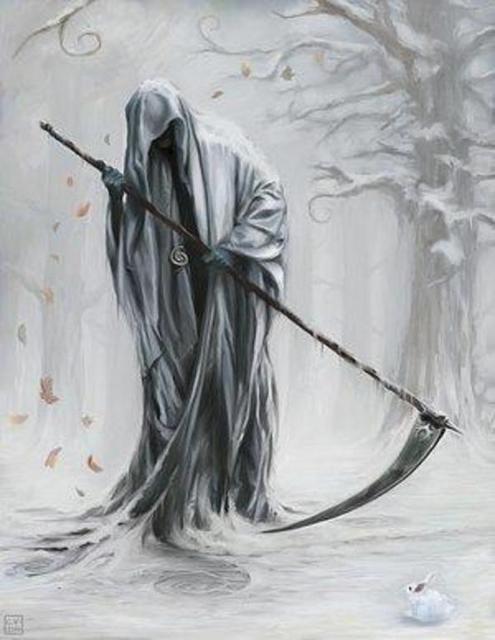
- The killer should wear a long black coat, and possibly a pair of black leather gloves to add to his suspicious, menacing, evil persona, connotively linking him with the Grim Reaper type figure of superstitious folklore.

Visual motifs/aesthetics:
- The colours used should deep, bold and almost stingingly painful to the eyes of the audience, for example, the reds should be really, really red, and the blacks should be really, really black.
Iconography:
- Symbolically, the secluded road acts as a metaphor for a route towards death. This setting should be lit with bright white light, as this serves to symbolise the passing into death.


Poster:
- We are considering using a still image from our finished film, which we feel will perfectly encompass the tone of our film. This image consists of our protagonist and our antagonist caught together within the same frame. Our protagonist (a young, naive boy) is pictured picking up a bloody wallet in the foreground and staring at it in bewilderment. In the foreground is our antagonist, watching the young boy looking at the wallet with murderous intent clearly on his mind.
Tuesday, 27 March 2012
Questionnaire analysis and findings
Planning - Target Audience Feedback:
1) Do you watch a lot of short films?
A majority of the people said no. This gives us the indication that it is going to be very hard for us to make a film that will appeal to our target audience. We are also oing to need to make something which will hook them and arrest them and send them raving. We feel that this will be a challenge, but a worthy one.
2) Do you prefer the film to focus more on character or story?
A majority of the people responded story. Again, in order to make our film as good and as successful as it can be, we are going to need to create an idea which will not only be pleasing to the audience, but also pleasing to us as artists.
3) What types of genre do you particularly enjoy?
4) Do you prefer your films to be more realistic or more fantasy?
Amongst the most popular choices were drama, comedy and horror. Since comedy is very hard to get a handle on, and is very difficult to make convincing, it might be worth trying to create a short film which has elements of horror but is mostly a drama, possibly trying to deal with events which take place in a day to day, realistic setting (this is evident in that, in our findings, a majority of the subjects preferred to have their films much more realistic than fantastical, possibly implying that realistic stories are much easier to identify with and much more accessible/easy to digest).
5) What is a particular type of setting you like to see in films?
A majority of the subjects chose cities, possibly implying that, because of the rise in popularity of films such as Kidulthood, that people in our target audience like to see a film set in an urban environment because it is easier for them to connect/identify with, and is much more in keeping with their sensibilities, personalities and lifestyles.
6) What kind of narrative do you enjoy?
This is the most difficult section to properly analyse, as there were varying opinions here, opinions which were much more scattered than the previous sections. Among the most popular selections were love and relationships, true crimes and murders, drug and gang issues, and poverty and realism. Here, we can either create a short film which incorporates all of these selections or, as it would be rather difficult to do that (because we would end up giving up more time to one theme than another), we could choose the one theme which appeals to us most of all and make the best film we can based on that.
7) Would you consider watching a short film that we have made sometime in the future?
A majority of the people said yes, thus giving us the indication that our film will be seen by, at the very least, a small audience, and that we have some support. However, some subjects also chose “If I’m Bothered,” thus implying that it is, as has been mentioned, going to be a very hard task to make a film which will appeal to and please everybody.
Target audience profile
Planning - Target Audience:
Our target audience is 16 to 24 year olds.
The three main reasons for this decision are as follows:
1) We are of this age range and thus, we can create a film which offers us a realistic and insightful look into current youth culture. We can offer this through our use of a narrative and mood that are very suspenseful, violent mysterious, through our construction of characters, specifically the representation of the protagonist, Dammy, linking with our own thoughts and feelings on the issues of youth violence which are occuring today, therefore represents the normality of inner-city reality and through our use of contemporary music, which is similar to the types of music to which people of this age range listen, for example, hip-hop and r'n'b.
2) Films such as Kidulthood and Adulthood which are, in essence, urban social realist dramas, have proved to be popular and profitable at the box office. What links these two films with our film is the concept of youth violence. In the same way that films such as these are comments on youth culture and crime, we intend our film to function as a comment on these modern issues as well, thus creating a film that our target audience would like and appreciate and respond well to. However, as well as trying to tell a conventional urban social realism drama, we will also attempt to combine the representation of urban reality with a sense of mystery and surrealism, in order to give our audience a film which differs from the crime dramas they are more familiar with, which will, in turn, heighten the viewing experience.
3) We want to offer our audience an insight into a lot of different types of classic films such as The Seventh Seal and Taxi Driver through exploiting techniques of intertextuality. In making reference to these films, if our film proves popular, not only will we have deepened the impact of our film through the connotations triggered by these allusions, we may have successfully persuaded our target audience to seek out these films to expand their knowledge of classic cinema.
Monday, 26 March 2012
Sunday, 25 March 2012
Location/Characters
Planning - Locations and Characters:
Characters :

This is an image of our main character, Dammy. We decided to present him wearing a light blue tracksuit, not only in order to connote that he is from an urban background and is very much a representation of urban youth today, but also to convey a sense of naivety about him, that the situation he has been thrown into is a situation which is outside his limited experience as a young man preoccupied with his studies.

We choose this actor to play the role of our villain due to his height and physicality. We asked him to convey through his speech, manner and body language the alarming and threatening presence we required our villain to exude. This image of our villain, although in a different costume from the one we eventually selected, conveys a sense of violence through the brandishing of a weapon, the blood stains on his jacket and his glazed, cold facial expression.
Locations:


We choose this location for our film because is perfectly captured the personality and lifestyle of the character that we were trying to convey, placing a lot of youthful and trendy/urban props such as a laptop, a PSP and a Harry Potter book, and also a copy of Jane Austen's Pride and Prejudice and a copy of the Bible with a cross leafed over it. This was all used to successfully put forward not only this character's naivety, but also his mindset and culture, specifically that he is a student and he is religious, the theme of religion adding subtly a deeper level for the overtones of death, murder and destruction seen throughout our film. In addition, it was a location that was most appropriate because it was convenient in terms of distance and the time.


Similarly, these two locations (located right next to our school) were utilised not only because of their short distance but also because it gave us the opportunity to get the best shot of our character coming out of his house.

This location, which was exactly the way we pictured the scene in the script, had to be abandoned out of consideration for the local residents' thoughts and feelings. However, we feel that the location that we did use eventually was perfect for our needs and got the point across just as well as this location would have.
Characters :

This is an image of our main character, Dammy. We decided to present him wearing a light blue tracksuit, not only in order to connote that he is from an urban background and is very much a representation of urban youth today, but also to convey a sense of naivety about him, that the situation he has been thrown into is a situation which is outside his limited experience as a young man preoccupied with his studies.

We choose this actor to play the role of our villain due to his height and physicality. We asked him to convey through his speech, manner and body language the alarming and threatening presence we required our villain to exude. This image of our villain, although in a different costume from the one we eventually selected, conveys a sense of violence through the brandishing of a weapon, the blood stains on his jacket and his glazed, cold facial expression.
Subscribe to:
Posts (Atom)